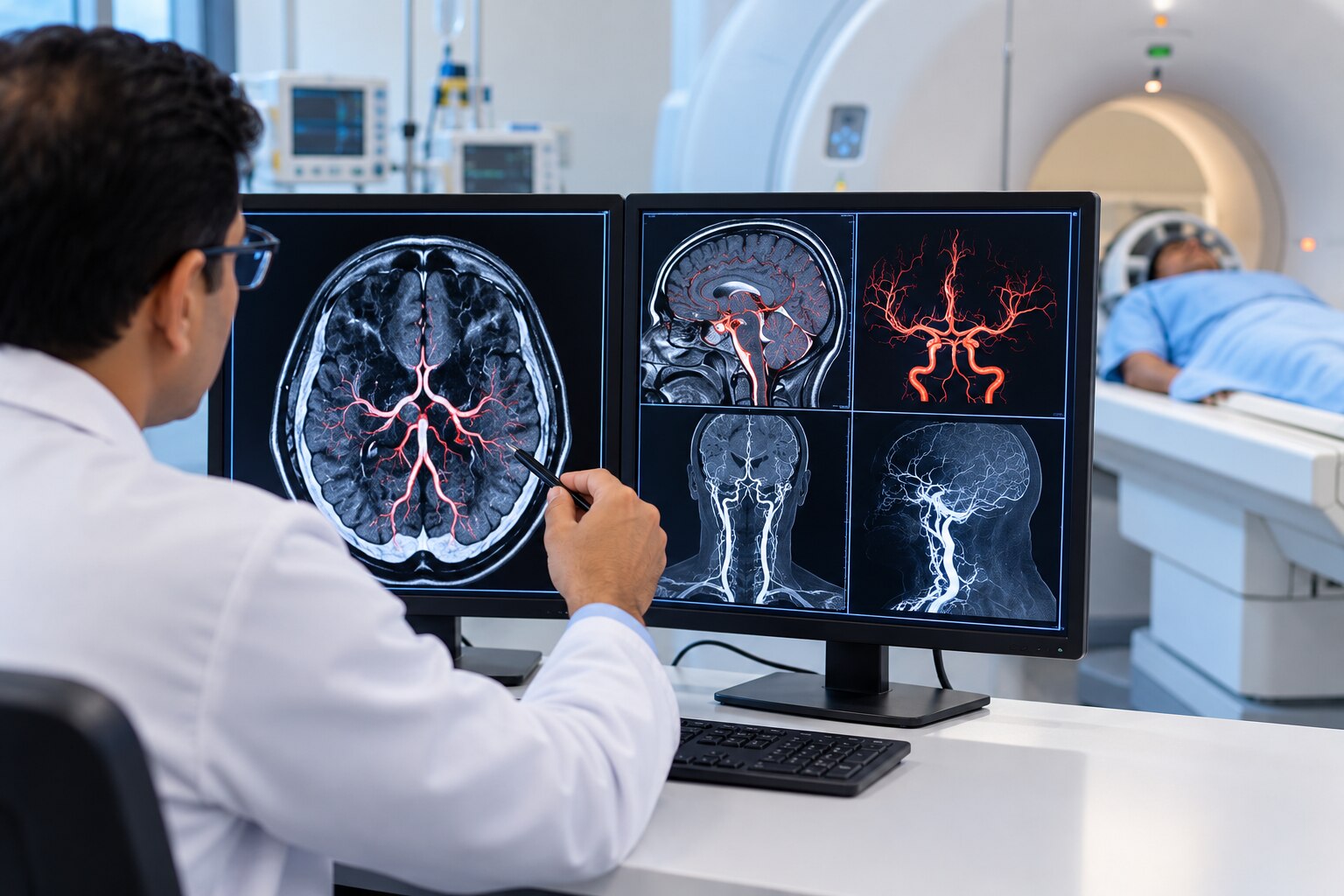
New facial drooping, one-sided weakness, speech trouble, loss of consciousness, seizure, or a sudden severe headache needs an emergency pathway, not a routine scan booking. By the end, you will know which Pune facility to call first, which questions to ask, and why the emergency doctor may order CT-based imaging before MRI.
Key takeaways
- Call 112 or go to an emergency department for sudden stroke-like symptoms.
- Do not book a routine scan appointment when symptoms are time-critical.
- Ask whether the facility provides CT head and CT angiography around the clock.
- Carry symptom onset time, medicines, medical records, and identification if available.
Choose the emergency route before choosing the scan
Call 112 or go straight to a hospital emergency department when symptoms could indicate stroke, brain haemorrhage, or another time-critical condition. Do not book a routine outpatient scan. For urgent neurovascular imaging in Pune, the emergency team can choose non-contrast CT head, CT angiography, or further imaging while arranging treatment or transfer.
Treat any of these as an emergency:
- New facial drooping or one-sided arm or leg weakness
- Slurred speech, inability to speak, or sudden confusion
- Sudden vision loss, severe imbalance, or loss of coordination
- A seizure, reduced consciousness, or fainting
- A sudden, unusually severe headache
Do not drive the patient to an imaging appointment. Call 112 when emergency transport is needed; tell the dispatcher the symptoms and confirm the destination hospital.
| Route | Choose it when | What happens next |
|---|---|---|
| 112 ambulance | The patient needs transport, monitoring, or cannot travel safely | The dispatcher helps coordinate emergency transport and destination |
| Hospital emergency department or stroke centre | Stroke, haemorrhage, seizure, or reduced consciousness is suspected | Clinicians assess immediately and usually start with non-contrast CT, adding CTA or other imaging when indicated |
| Routine diagnostic centre | Only when a clinician has confirmed that symptoms are not an emergency | The scan is scheduled without providing acute stroke treatment or thrombectomy transfer |
“MRI available” alone is not enough. Ask whether CT head and CTA head/neck are immediately available, whether urgent interpretation is provided, and whether the hospital can transfer a suitable thrombectomy patient. Carry the exact last-known-well time, medicines, recent surgery, bleeding history, kidney disease, and contrast reactions without delaying departure.
Where to call first in Pune
Call a hospital emergency department with acute stroke capability, a stroke centre, or a tertiary-care hospital that can perform non-contrast CT head and CT angiography of the head and neck immediately. A routine diagnostic centre that offers only scheduled CT or MRI cannot complete the urgent work-up for a suspected large-vessel blockage.
| Pune facility | What it must provide | What to ask |
|---|---|---|
| Hospital emergency department | Immediate assessment, CT head, CTA head and neck, urgent reporting, and transfer arrangements | “Can you perform CT head and CTA head/neck now, and can your team arrange thrombectomy transfer?” |
| Stroke centre or tertiary-care hospital | Emergency stroke team, CT-based imaging, specialist interpretation, and endovascular referral or treatment | “Is a stroke physician or radiologist available urgently, and is catheter angiography available on site or through a rapid pathway?” |
| Standalone diagnostic centre | Fast imaging only when it has 24-hour emergency access and a documented hospital transfer link | “Will you scan immediately, report it urgently, and transfer a suspected stroke patient without sending the family to arrange everything?” |
Searches for neurovascular imaging near me should therefore check the emergency pathway, not just the nearest machine. Ask whether CT head and CTA are available now; “MRI available” does not prove acute stroke capability.
Give the dispatcher or emergency team the exact last-known-well time, symptom progression, anticoagulant or antiplatelet use, recent surgery or bleeding, kidney disease, prior disability, and contrast reaction. If transport is needed, call 112 and confirm the destination with the dispatcher. Don’t delay transfer while calling multiple scan centres.
Know what each neurovascular scan is for
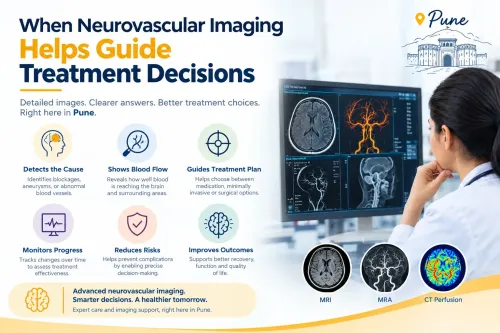
For suspected acute stroke or brain haemorrhage, a non-contrast CT head usually comes first. It quickly shows bleeding and major swelling, helping the emergency team decide treatment without waiting for MRI. If a large-vessel blockage is possible, CTA of the head and neck follows when available.
| Scan | What it shows | Main use |
|---|---|---|
| Non-contrast CT head | Blood, swelling, and early structural change | First scan for suspected stroke or haemorrhage |
| CT angiography (CTA) | Arteries from the head through the neck | Finds blockages, aneurysms, or narrowing; guides thrombectomy decisions |
| CT perfusion | Brain blood flow and tissue at risk | Helps select some late-presenting stroke patients |
| MRI brain with diffusion | Acute infarcted tissue with high sensitivity | Confirms many ischaemic strokes when time, monitoring, and patient stability permit |
| MR angiography (MRA) | Arteries without catheter insertion | Evaluates vessel narrowing, blockage, or aneurysm |
| MR venography (MRV) | Veins and venous sinuses | Investigates cerebral venous thrombosis |
| Catheter cerebral angiography | Detailed, live arterial images | Used for definitive assessment or endovascular treatment |
MRI is not automatically the best first test: scan time, movement, implanted devices, and monitoring access can delay care. CT perfusion or diffusion MRI supplements the initial assessment rather than replacing it.
When seeking emergency brain vessel imaging in Pune, ask whether non-contrast CT and CTA head/neck are immediately available, who interprets them urgently, and whether the hospital can arrange thrombectomy transfer. “MRI available” alone does not prove stroke capability.
Compare facilities by capability, not by advertising
Choose the site by capability, not branding: urgent neurovascular imaging in Pune requires non-contrast CT head and CTA of the head and neck immediately, urgent interpretation, and a route into stroke treatment. “MRI available” alone proves little; a delayed MRI does not replace an acute stroke pathway.
| Facility | Confirm before choosing | Warning sign |
|---|---|---|
| Hospital emergency department | 24-hour CT, CTA, radiologist, stroke clinician, and transfer protocol | Routine scan booking or no emergency intake |
| Stroke centre | Immediate CT/CTA, stroke assessment, and on-site treatment or rapid thrombectomy transfer | No documented large-vessel-occlusion pathway |
| Tertiary-care hospital | CT/CTA, intensive care, neurology, anaesthesia, and endovascular service or transfer link | MRI-only capability |
| Diagnostic centre | Emergency CT/CTA, rapid reporting, and direct handoff to an emergency department | Outpatient slot with no acute-care team |
Before travelling, ask:
- Can you perform non-contrast CT and CTA now, not merely MRI?
- Who will interpret the scans, and how quickly?
- If CTA finds a large-vessel blockage, where will thrombectomy occur?
- Will your emergency department receive the patient directly?
A normal early CT does not exclude ischaemic stroke, so persistent weakness, speech trouble, or facial drooping still needs urgent neurological assessment. Dr Santosh Patil-Endovascular Neuro Surgeon Pune can help assess whether vascular imaging supports specialist endovascular referral, but that consultation must not delay emergency transport.
Related service
Neurovascular Imaging What is Neurovascular Imaging- Neurovascular imaging plays a crucial role in the diagnosis, characterization, and treatment planning of the... View service → |
Prepare the key details without delaying transport
Carry the patient’s exact last-known-well time, not merely the time symptoms were noticed. If the person woke with symptoms, record the last time they were definitely normal. Take medication strips or a current list, especially anticoagulants and antiplatelets.
- Write down when each symptom began and whether it progressed.
- Note recent surgery, bleeding, kidney disease, pregnancy, prior disability, and any severe reaction to iodinated contrast.
- Carry identification, previous brain scans, discharge summaries, and the treating doctor’s contact details.
- Tell the emergency team about seizures, loss of consciousness, facial drooping, speech trouble, or one-sided weakness.
A neurovascular scan appointment in Pune is the wrong route for sudden neurological symptoms, a severe abrupt headache, seizure, fainting, or new weakness. Call 112 or go directly to a hospital emergency department; do not wait for an outpatient slot or drive the patient if emergency transport is needed.
Ask whether the facility can perform non-contrast CT head and CTA of the head and neck immediately, obtain urgent interpretation, and transfer eligible patients for thrombectomy. “MRI available” alone is not enough.
A routine diagnostic centre offering only CT may leave the initial stroke work-up incomplete, while contrast concerns should be assessed by clinicians rather than causing a dangerous delay.
Frequently asked questions
Where should I go for urgent neurovascular imaging in Pune?
Call 112 or go directly to a hospital emergency department when symptoms suggest stroke, brain haemorrhage, or another time-critical condition. The emergency team can arrange the appropriate scan and treatment pathway.
Which scans are used for emergency brain vessel imaging in Pune?
The emergency team may choose a non-contrast CT head, CT angiography, or additional imaging based on your symptoms and examination. Do not select a routine outpatient scan yourself.
How do I compare facilities for neurovascular imaging near me?
Check whether the facility has 24-hour emergency imaging, CT head, CT angiography, stroke assessment, specialist interpretation, and a plan for urgent treatment or transfer.
What should I take to a neurovascular scan appointment in Pune?
For an emergency, do not delay transport to collect documents. Take the symptom onset time, current medicines, allergies, medical records, previous scans, and identification if they are immediately available.
Keywords