A suspected stroke needs emergency imaging before anyone can decide whether medication, clot removal, or both offer the safest route. You will be able to recognise the warning signs, understand the treatment windows, compare thrombolysis with thrombectomy, and ask a Pune hospital the right capability and transfer questions.
Key takeaways
- Call emergency services and record the last-known-well time.
- Brain imaging identifies bleeding, blocked vessels, and treatment eligibility.
- Medication may dissolve clots; thrombectomy physically removes selected large clots.
- Compare hospitals by imaging, neurointerventional expertise, and transfer speed.
What must happen before doctors choose a stroke treatment?
Face drooping, arm weakness, speech difficulty, or sudden vision or balance problems demand an emergency call. Call emergency services immediately, record the last-known-well time—the last time the person was definitely normal—avoid driving independently, and do not wait for symptoms to improve. The clock starts there, not when someone noticed the change.
These details help clinicians assess ischemic stroke treatment options in Pune.
- Emergency neurological assessment includes consciousness, speech, strength, vision, coordination, and the NIH Stroke Scale (NIHSS), which records deficit severity.
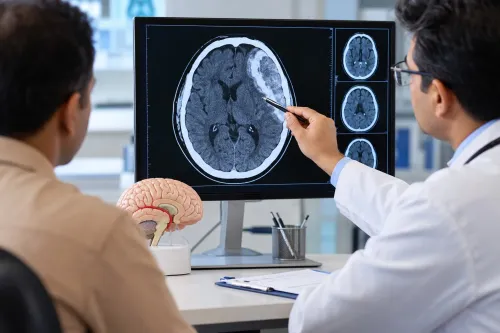
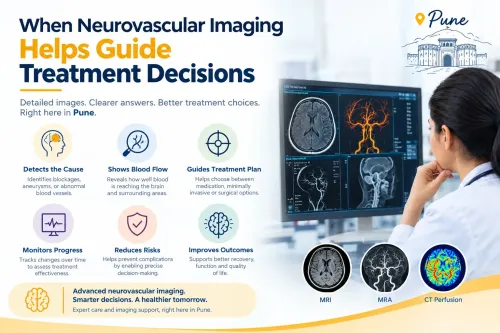
- A non-contrast CT looks for intracranial bleeding and estimates established brain damage. A mild-looking early CT does not exclude a severe blockage.
- CT angiography locates a large-vessel occlusion. CT perfusion or MRI-based imaging can help assess selected late presenters.
| Option | What clinicians need to see | What it supports |
|---|---|---|
| Medication treatment | No bleed on CT, appropriate clinical deficit, treatment timing, blood pressure, medicines, and bleeding history | Intravenous reperfusion medication or another clinically indicated drug |
| Thrombectomy | CTA-confirmed treatable vessel blockage, infarct core size, neurological deficit, and treatment timing | Catheter-based clot removal when expected benefit outweighs risk |
| Either pathway | Vessel location, bleeding risk, prior medicines, recent surgery, baseline disability, and general medical fitness | An individual plan, including combined treatment when eligible |
When does medication treatment help, and what does it include?
Medication treatment means either intravenous clot-dissolving treatment or tablet-based prevention; these are not interchangeable options.
| Treatment | What it does | When it applies |
|---|---|---|
| Alteplase or tenecteplase | Travels through a vein to dissolve clot | Selected disabling strokes within the treatment window |
| Aspirin or another antiplatelet | Limits platelet-driven clot extension and recurrence | When reperfusion is not indicated or after the acute plan |
| Anticoagulant | Reduces clot formation through the clotting system | Specific indications, such as a later-confirmed cardioembolic source |
For a disabling ischemic stroke, clinicians assess intravenous thrombolysis within 4.5 hours of the last-known-well time. They do not decide from the clock alone.
- Non-contrast CT findings, including evidence of bleeding or established infarction
- Blood pressure and whether it can be safely controlled
- Recent anticoagulant use, including the drug and last dose
- Recent surgery, serious bleeding, or other contraindications
- Baseline disability and the severity of the current deficit
Aspirin is not an equivalent substitute for urgent reperfusion when CT angiography shows an eligible large-vessel occlusion. It does not mechanically remove an established major clot. Anticoagulants are also not automatic emergency clot treatments; doctors use them for defined causes and timing, including a cardioembolic source confirmed during the evaluation.
When comparing ischemic stroke thrombectomy or medication in Pune, ask whether “medication” means thrombolysis or tablets. That distinction matters when reviewing ischemic stroke treatment options in Pune, because delaying reperfusion for aspirin can cost recoverable brain function.
When is thrombectomy better than medication alone?
Thrombectomy is considered when CT angiography confirms a treatable large-vessel occlusion, such as a blockage in the internal carotid artery or proximal middle cerebral artery, and the patient has a significant neurological deficit with a relatively small established infarct. In that situation, medication alone is not an equivalent substitute for removing the clot.
| Option | What it does | When it applies |
|---|---|---|
| Medication alone | Uses intravenous thrombolysis to dissolve clot, or antiplatelet treatment to limit platelet-driven extension | When no thrombectomy-eligible occlusion exists, or endovascular treatment is unsuitable |
| Thrombectomy | Removes the clot mechanically from the cerebral artery | When CTA shows an eligible major-artery blockage and imaging shows salvageable brain |
| Both treatments | Gives thrombolysis promptly while arranging clot removal | When the patient qualifies for intravenous thrombolysis and thrombectomy |
For stroke clot removal in Pune, a catheter enters through an artery in the groin or wrist and travels to the brain under angiographic imaging. Aspiration, a stent-retriever, or both remove the obstruction. This is not open brain surgery, but it requires an experienced neurointerventional team, anaesthesia or sedation, angiography equipment, and intensive stroke monitoring.
Teams usually assess stroke thrombectomy in pune within 6 hours. Selected patients qualify between 6 and 16 hours, or up to 24 hours, when clinical findings and brain imaging show a mismatch: severe symptoms despite a relatively small established infarct.
If thrombolysis is also appropriate, doctors generally give it without waiting to see whether it works before proceeding with thrombectomy.
How should families compare hospitals and emergency transfer options in Pune?
Choose the receiving hospital by confirmed capability, not by an advertisement for stroke treatment. Ask whether it provides all of these services around the clock:
- Emergency non-contrast CT and CT angiography
- Intravenous thrombolysis with alteplase or tenecteplase
- Mechanical thrombectomy
- Neurocritical care and anaesthesia
- Post-procedure monitoring by a stroke or intensive-care team
| Route | What to verify | Main concern |
|---|---|---|
| Direct comprehensive stroke centre | CT, CTA, thrombolysis and thrombectomy are available immediately | Travel time must not erase the treatment advantage |
| Nearest emergency hospital | It can scan, start eligible thrombolysis and arrange rapid transfer | It may not have a 24-hour neurointerventional team |
| Transfer pathway | A receiving specialist has accepted the patient and imaging can be shared | Unconfirmed transfers create avoidable delays |
Give the ambulance team and receiving hospital precise information:
- The last-known-well time, or witnessed normal time
- When symptoms were first noticed
- NIH Stroke Scale findings, if recorded
- Anticoagulant or antiplatelet medicines
- Recent surgery, bleeding or previous imaging
- Baseline mobility, speech and independence
A hospital may transfer the patient for CTA review, stroke thrombectomy in Pune, stroke clot removal in pune, neurocritical care or post-procedure monitoring. Do not delay transfer while waiting for a later-window assessment; earlier reperfusion generally provides greater benefit, and 6-to-24-hour pathways apply only to selected patients.
Dr Santosh Patil-Endovascular Neuro Surgeon Pune can help interpret whether the vessel location, imaging and clinical status fit an endovascular pathway, but specialist discussion must never delay emergency services or hospital transfer.
Related services
Ischemic Stroke Treatment in Pune Ischemic Stroke Treatment in Pune What is Ischemic Stroke ? Ischemic stroke, characterized by the obstruction of blood flow to the brain, demands swift and comprehensive intervention... View service → |
Endovascular Neuro Surgeon/Interventional Neuro Radiologist Endovascular Neuro Surgeon/Interventional Neuro Radiologist in Pune Dr Santosh Patil is the Best Endovascular Neuro Surgeon in Pune and Interventional Neuro Radiologist in Pune, Maharashtra and all over India. View service → |
What risks and follow-up care remain after the immediate decision?
Neither treatment guarantees recovery: brain tissue already injured by interrupted blood flow may not recover, and the vessel may remain blocked. In comparing ischemic stroke treatment options in Pune, doctors weigh the expected neurological benefit against treatment risks, not assume thrombectomy is universally safer.
| Option | Main risks | Important limitation |
|---|---|---|
| Intravenous thrombolysis | Intracranial or other bleeding, including bleeding elsewhere in the body | Alteplase or tenecteplase may fail to dissolve the clot |
| Thrombectomy | Intracranial or other bleeding, vessel injury, embolisation to another artery, contrast reaction or kidney injury, and anaesthesia complications | The catheter procedure may fail to reopen the vessel |
| Antiplatelet or anticoagulant medicine | Bleeding, with the risk depending on the drug and the patient | These medicines do not mechanically remove an established large-artery clot |
After reperfusion or medical treatment, clinicians investigate why the stroke occurred. Follow-up can include heart-rhythm monitoring for atrial fibrillation, carotid imaging for carotid disease, and checks of blood pressure, diabetes, and smoking. Doctors prescribe an antiplatelet drug or an anticoagulant when the identified cause makes one appropriate; neither is automatic for every patient.
This distinction matters when discussing ischemic stroke thrombectomy or medication in Pune.
Thrombectomy removes the immediate blockage, but it does not repair the underlying cause. Secondary prevention therefore continues through prescribed medication, blood-pressure and diabetes control, smoking cessation, rehabilitation, and monitoring for recurrent symptoms or treatment complications.
Frequently asked questions
What must happen before doctors choose an ischemic stroke treatment?
Doctors establish the last-known-well time, perform neurological assessment, and use brain imaging to distinguish bleeding from an artery blockage. CT angiography can identify a large-vessel occlusion, while additional perfusion imaging may help select patients for thrombectomy.
When does medication treatment help, and what does it include?
Eligible patients may receive intravenous thrombolysis to dissolve a clot after doctors exclude bleeding and assess factors such as timing, medicines, and bleeding risk. Medication does not replace thrombectomy when a removable large-vessel clot requires mechanical treatment.
When is thrombectomy better than medication alone?
Thrombectomy is considered when imaging shows a treatable large-vessel blockage and the patient meets clinical and timing criteria. A catheter removes the clot through an artery, while medication alone may not reopen that vessel quickly enough.
How should families compare hospitals and emergency transfer options in Pune?
Ask whether the hospital provides 24-hour stroke imaging, emergency thrombolysis assessment, neurointerventional thrombectomy, anaesthesia support, intensive care, and a documented transfer pathway. Prioritise the fastest safe route rather than waiting to arrange a preferred hospital.
What risks and follow-up care remain after treatment?
Risks include bleeding, recurrent stroke, vessel injury, brain swelling, and complications from immobility or the procedure. Follow-up commonly includes blood-pressure and diabetes control, cause evaluation, antiplatelet or anticoagulant treatment when prescribed, rehabilitation, and warning-sign education.
Related service
Neurovascular Imaging What is Neurovascular Imaging- Neurovascular imaging plays a crucial role in the diagnosis, characterization, and treatment planning of the... View service → |
Keywords