A head or neck lesion deserves assessment when it changes, bleeds, hurts, swells, or interferes with breathing, swallowing, speech, vision, hearing or movement. You will be able to identify emergency warning signs, understand how symptoms differ by lesion type and location, and prepare for a safer first evaluation.
Key takeaways
- Seek prompt assessment for growth, pain, warmth, pulsation, bleeding, or recurrent swelling.
- Low-flow and high-flow lesions produce different symptoms and examination findings.
- Imaging helps distinguish vascular malformations from cysts, infections, haemangiomas, and other masses.
- Bring symptom timing, photographs, previous scans, and medication details to your Pune consultation.
Which changes mean a head or neck lesion needs prompt assessment?
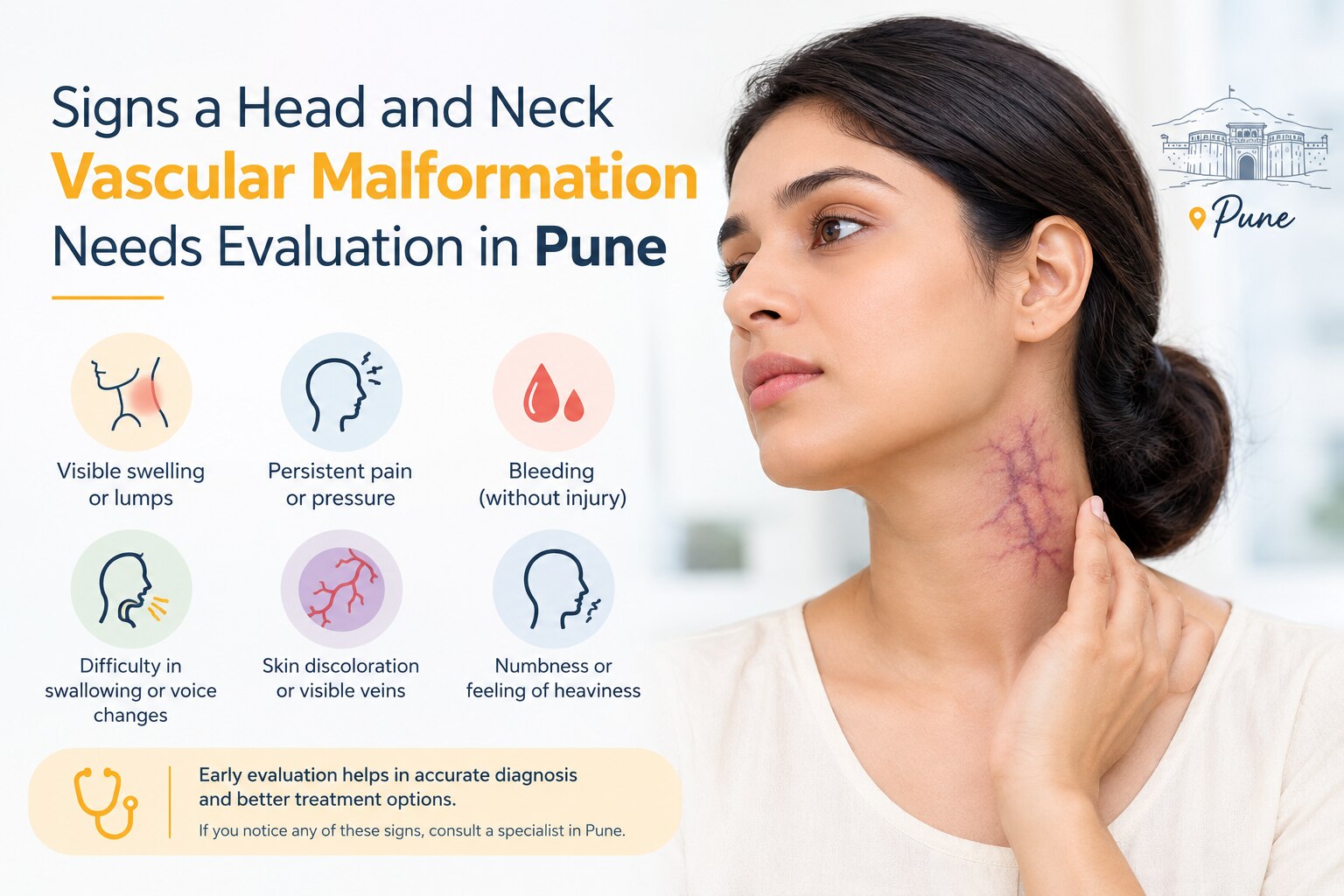
Arrange a head and neck vascular malformation evaluation in Pune if a lesion enlarges, becomes newly noticeable, painful, repeatedly swollen, warmer, pulsatile, or develops a bruit. Skin or mucosal colour change, recurrent ulceration, or bleeding also warrants assessment.
A painless, stable lesion still needs review if it affects the tongue, airway, orbit, jaw, swallowing, speech, appearance, or if no clinician has confirmed the diagnosis.
Seek emergency services rather than a routine appointment for:
- Sudden airway difficulty, noisy breathing, choking, or inability to swallow saliva
- Rapidly increasing tongue, floor-of-mouth, or neck swelling
- Bleeding that does not stop after firm, continuous pressure
- New weakness, facial droop, speech trouble, vision loss, seizure, or sudden severe headache
A head and neck vascular lesion in Pune needs prompt clinical review when pain or swelling appears, even without an emergency symptom. Sudden pain or enlargement in a soft, bluish lesion may indicate thrombosis or local haemorrhage; fever, spreading redness, warmth, and pus point more toward infection.
| Concern | What it may indicate | Action |
|---|---|---|
| Stable and painless | Functional or cosmetic impact, or an unconfirmed diagnosis | Arrange assessment |
| Sudden pain or enlargement | Thrombosis or local haemorrhage | Seek prompt review |
| Fever, redness, warmth, or pus | Infection | Seek prompt review |
| Pulsation, bruit, or rapid swelling | Higher-flow vascular lesion | Arrange specialist assessment promptly |
How do symptoms vary by flow type and location?
The same lesion can cause different problems depending on its vessels and location. A soft cheek or lip swelling may affect eating or appearance, while tongue enlargement, jaw restriction or neck fullness can impair movement and swallowing. A small lesion becomes serious when it involves the airway, eye or major nerves.
| Flow type | Typical symptom pattern | Important warning |
|---|---|---|
| Venous | Soft, compressible and sometimes bluish; enlarges when you bend or strain. Thrombosis, injury or infection can cause pain and swelling. | Cheek, lip or neck lesions may enlarge; tongue involvement can restrict speech or swallowing. |
| Low-flow lymphatic | Spongy tissue, clusters of small blisters or clear fluid leakage; expands during infection or bleeding. | Throat swelling can cause voice change, snoring, choking or airway obstruction. |
| Arteriovenous | Pulsates, feels warm, refills quickly after compression, or produces a bruit or palpable thrill. | It can bleed and damage nearby tissue; scalp or ear bleeding needs prompt assessment. |
| Mixed | Combines venous, lymphatic and high-flow findings. | Symptoms depend on depth and site, including neck fullness or airway compromise. |
Orbit lesions can cause pain, bulging or vision change even when they are small. These findings do not prove the flow type or diagnosis, so do not arrange biopsy or removal before vascular assessment.
A clinician evaluating vascular malformation symptoms in Pune will match examination and imaging to the pattern; a head and neck vascular lesion in Pune needs prompt review if it bleeds, enlarges or affects breathing, vision or swallowing.
Could the lump be a haemangioma, cyst, infection or another mass?
Colour and size cannot establish what a head or neck lump is. A vascular malformation is usually present from birth, but it can stay hidden until puberty, infection, injury, pregnancy or another hormonal change makes it enlarge or hurt. Searching for vascular malformation symptoms in Pune does not replace examination.
Infantile haemangioma is different: it is a vascular tumour that usually appears after birth and follows its own growth pattern. A clinician must also consider:
- Lymph-node swelling, a salivary-gland mass, a thyroid lump, an abscess, a cyst or another tumour.
- Warmth, redness and pus, which point toward infection rather than proving a vascular lesion.
- Compressibility, enlargement when you bend or strain, pulsation, rapid refill after compression, a palpable thrill or a bruit, which raise concern for a vascular process.
A firm new component, persistent progressive enlargement, unexplained ulceration or atypical imaging needs reassessment. Do not assume an old malformation explains every new change.
Do not arrange an office biopsy, excision or cosmetic procedure before vascular assessment. A high-flow arteriovenous lesion can bleed substantially, and casual tissue sampling can create an avoidable emergency. A head neck vascular malformation specialist in Pune should decide whether imaging, planned biopsy or another test is safe.
What happens during the first evaluation?
The first visit starts with a detailed history. Expect questions about when the lesion appeared, changes with position or straining, pain, bleeding, infection, trauma, puberty, pregnancy, previous injections or surgery, and anticoagulant use. This history helps distinguish a stable malformation from a new complication.
Bring childhood records, earlier scans, current medicines, details of bleeding or pain episodes, and dated photographs showing change over time. Mention any effect on swallowing, speech, breathing, vision or movement.
- Examination begins with inspection at rest, followed by assessment during position change or straining.
- Palpation checks compressibility, warmth, pulsation and a thrill; the clinician also reviews swallowing, speech, breathing, vision and movement.
- Ask whether duplex Doppler ultrasound suits a superficial lesion. It assesses compressibility, venous flow and high-flow arterial features without radiation.
- Deep lesions involving the airway, orbit, skull base, muscles or brain often need contrast MRI with MR angiographic or venographic sequences.
- Catheter angiography is an invasive planning test used when feeding arteries must be mapped, especially for suspected arteriovenous malformation.
The imaging choice depends on depth, flow and nearby structures, not appearance alone. During a head and neck vascular malformation evaluation in Pune, ask how the proposed test will define treatment risk and whether deeper extension has been considered.
If you are researching vascular malformation symptoms in Pune, take photographs from different dates and write down episodes of swelling, bleeding or infection before the appointment.
How should you choose care and prepare for a Pune consultation?
Choose care by urgency first, then by the lesion’s anatomy. Use emergency services for airway compromise, rapidly increasing tongue or neck swelling, bleeding that does not stop with firm pressure, new weakness, facial droop, speech trouble, vision loss, seizure or sudden severe headache.
| Situation | Action | Why it matters |
|---|---|---|
| Breathing difficulty, choking, uncontrolled bleeding or sudden neurological symptoms | Emergency care now | Delay can threaten the airway, brain or circulation |
| Enlargement, recurrent pain, bleeding, ulceration or functional problems | Prompt specialist review | Thrombosis, haemorrhage, infection or high-flow disease needs assessment |
| Painless, stable lesion without a confirmed diagnosis | Non-urgent evaluation | Colour and size cannot establish the diagnosis |
Treatment depends on flow type, depth, anatomy and symptoms, not visibility alone. Options include observation, selected compression, percutaneous sclerotherapy, endovascular embolisation, surgery, laser treatment or systemic medication; extensive disease may need staged combined treatment.
For a head neck vascular malformation specialist in Pune, ask:
- Can interventional radiology or neuroradiology, head-and-neck surgery and diagnostic radiology coordinate my care?
- Do you evaluate deep or high-flow lesions, including airway, orbit or skull-base disease?
- Is duplex Doppler ultrasound, contrast MRI or angiography appropriate?
- What symptoms should trigger emergency review?
A service offering only cosmetic removal may not map high-flow disease safely. Dr Santosh Patil-Endovascular Neuro Surgeon Pune may be relevant for neurovascular and image-guided assessment; choose based on urgency, anatomy and required expertise when arranging head and neck vascular malformation evaluation in Pune.
Related service
Head And Neck Vascular Malformations Head And Neck Vascular Malformations What is Head & Neck Vascular Malformations- Head & Neck Vascular Malformations encompass a diverse group of anomalies involving abnormal blood... View service → |
Frequently asked questions
Which changes mean a head or neck vascular malformation needs prompt assessment?
Arrange assessment if the lesion enlarges, becomes newly noticeable, painful, warm, pulsatile, repeatedly swollen, or develops a bruit. Colour change, recurrent ulceration, and bleeding also require evaluation.
How do symptoms vary by flow type and location?
Low-flow venous lesions often appear soft, compressible, and bluish, with swelling that increases during straining or dependency. Lymphatic lesions can cause soft, fluid-filled swelling. High-flow arteriovenous lesions may feel pulsatile, produce a bruit, and cause warmth. Location affects symptoms: lesions near the airway, tongue, eye, ear, or swallowing muscles can interfere with breathing, vision, hearing, speech, or swallowing.
Could the lump be a haemangioma, cyst, infection, or another mass?
Yes. A head or neck lump can result from a vascular malformation, haemangioma, cyst, infection, lymph node, salivary-gland lesion, or tumour. Clinical examination and imaging help identify blood flow, tissue depth, and the structure involved.
What happens during the first evaluation?
The clinician reviews when the lump appeared, how it changes, pain or bleeding, prior procedures, and relevant medical history. Examination checks colour, compressibility, pulsation, warmth, bruit, skin changes, and effects on nearby functions. Ultrasound with Doppler, MRI, CT, or angiography is selected according to the lesion and the information needed.
How should you prepare for a Pune consultation?
Bring previous scan reports and images, a list of medicines and allergies, details of earlier treatment, and dated photographs showing changes. Note triggers such as exercise, crying, infection, dependency, or injury. Choose a head and neck vascular malformation specialist in Pune with access to appropriate imaging and multidisciplinary treatment planning.
Keywords