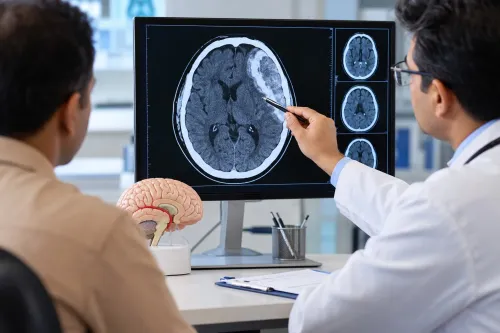
Leaving hospital after a subdural bleed does not mean recovery is complete: symptoms, medicines, mobility and repeat scans still need a clear plan. By the end, you will know what discharge involves, which changes need emergency assessment, how treatment type affects recovery, and what to ask your Pune care team.
Key takeaways
- Confirm stable neurological examinations before discharge.
- Seek emergency help for worsening headache, weakness, confusion or seizures.
- Keep every scan, medicine list and follow-up appointment recorded.
- Arrange supervision and fall prevention before returning home.
What happens from treatment to hospital discharge?
Discharge follows a stable neurological examination, not simply the end of a procedure. After observation, clinicians repeat examinations and imaging as needed; after burr-hole drainage, craniotomy or an endovascular procedure, they monitor the wound, drain, brain pressure, swallowing, movement and symptoms.
1. An acute subdural hematoma with substantial brain compression needs urgent decompression. Clot thicker than 10 mm or midline shift greater than 5 mm generally warrants evacuation, regardless of Glasgow Coma Scale score. A burr hole commonly drains a chronic collection, while craniotomy is used when clot, membranes or recurrence require wider access.
2. Middle meningeal artery embolization targets the vascularized membrane that helps sustain many chronic subdural hematomas. It does not instantly remove blood already inside the skull, so clinicians consider it alongside drainage or for selected recurrent or high-operative-risk chronic cases—not as a replacement for emergency decompression.
3. Hospital stay varies with consciousness, brain compression, age, other illnesses, swallowing, walking and the need for rehabilitation. Someone alert and walking safely may leave sooner than a person with weakness, confusion, aspiration risk or significant medical problems.
4. Before discharge, the team confirms stable examinations, controlled pain and vomiting, safe swallowing, a medication plan, supervision arrangements and scheduled review or CT imaging. Residual fluid on a scan does not automatically mean failure; symptoms, examination and mass effect determine its significance.
Recovery after subdural hemorrhage treatment in Pune can include weeks of fatigue, imbalance, slowed thinking or weakness. Worsening drowsiness, confusion, weakness, speech difficulty, repeated vomiting or a seizure needs urgent assessment rather than routine follow-up.
Which symptoms are expected, and which require emergency help?
Headache, fatigue, dizziness, imbalance, weakness, slowed thinking, memory difficulty, confusion and speech changes can occur during early recovery. They should gradually improve as the brain recovers, but worsening symptoms need urgent assessment rather than a routine review.
| Symptom pattern | What it may indicate | What to do |
|---|---|---|
| Expected, mild and improving | Recovery after the bleed or procedure | Rest, follow the discharge plan and report persistent symptoms at review |
| Worsening or severe headache, repeated vomiting, increasing drowsiness or confusion | Recurrent bleeding or raised intracranial pressure | Call emergency services or return to the treating hospital immediately |
| Unequal pupils, new one-sided weakness or numbness, facial drooping, slurred speech or vision change | New neurological deterioration | Seek emergency help immediately |
| A new seizure or loss of consciousness | Seizure, recurrent bleeding or raised intracranial pressure | Call emergency services; do not drive the person yourself |
| Fever with wound redness, swelling, drainage or opening | Infection | Contact the treating hospital urgently |
| A fall with head impact | Rebleeding or another head injury | Return to the treating hospital for assessment, even if the person appears well |
Do not wait for a scheduled Pune follow-up if any warning sign appears. Recurrent bleeding, raised intracranial pressure, infection or seizure can worsen quickly. During subdural bleed treatment in Pune, keep the discharge summary and hospital contact number available, and tell emergency staff about the procedure, medicines and time symptoms began.
How do medicines, scans and follow-up shape recovery?
Follow-up combines medication review, neurological examination and imaging—not the scan alone. Residual fluid on a postoperative CT does not automatically mean treatment failed; clinicians compare it with symptoms, examination findings and mass effect.
1. Keep the scheduled neurosurgical review, even if recovery feels steady. Chronic subdural collections can recur or temporarily enlarge while the membrane settles, so the team may order a repeat CT. Worsening weakness, confusion, drowsiness, speech difficulty, repeated vomiting or a new seizure needs urgent assessment.
2. Do not stop or restart aspirin, clopidogrel or an anticoagulant yourself. Neurosurgery and the prescribing specialist must weigh rebleeding and recurrence against the danger of withholding treatment for a mechanical valve, recent coronary stent, atrial fibrillation or prior stroke.
3. Ask why an antiseizure medicine is prescribed and when it will be reviewed. It is not automatically lifelong; duration depends on seizures, cortical injury, surgery and neurological assessment. For severe traumatic brain injury, guidance supports early seizure prevention during the first seven days, but this does not prevent late post-traumatic epilepsy.
4. Take the discharge summary, scan reports and complete medicine list to every appointment. If you are arranging subdural hemorrhage care in Pune, confirm who reviews new symptoms, who orders repeat imaging and how quickly you can reach neurosurgical care. Recovery decisions should follow the patient’s examination, not a single measurement on a scan.
What help is needed at home, and when can normal activities resume?
At home, reduce falls before the patient starts walking more. Clear loose rugs and floor clutter, improve lighting in corridors and bathrooms, supervise stairs, and use the prescribed walking aid rather than furniture for support.
- Keep pathways and stair edges clear.
- Add night-lights near the bed and toilet.
- Stay beside the patient on stairs until the treating team confirms it is safe.
- Do not change or stop prescribed medicines without advice.
Record alertness, medication-taking, speech, strength, behaviour and balance, with the time of each change. This record helps the follow-up team identify gradual decline, medication effects or recovery after brain hemorrhage in Pune.
Ask for physiotherapy when weakness, poor balance or deconditioning limits movement. Occupational therapy helps with bathing, dressing, kitchen tasks and home adaptations. Arrange speech-and-swallow assessment for slurred speech, choking or unsafe swallowing. Cognitive rehabilitation or neuropsychological assessment helps when limb strength has returned but the person remains slow, tired, forgetful or unsteady.
There is no safe universal date for normal activities. Walk alone or climb stairs only after supervised practice shows stable balance; return to work when concentration and stamina match the job; and resume exercise, cycling, alcohol and sexual activity gradually after clinical advice.
Driving and cycling require treating neurologist clearance if seizures, sedating medicines, visual problems, slow reactions, imbalance or cognitive impairment remain. Pause any activity that causes dizziness, worsening headache or marked fatigue.
What should you verify when arranging ongoing subdural care in Pune?
Before choosing ongoing subdural bleed treatment in Pune, verify the hospital’s actual pathway rather than assuming that location or an endovascular service guarantees complete follow-up.
1. Ask whether 24-hour neurosurgical cover is available, including overnight review for worsening headache, drowsiness, weakness or seizures.
2. Confirm access to urgent CT, catheter angiography and neurocritical-care monitoring when your condition requires them. Ask who reviews an abnormal scan and where you would be transferred if the hospital lacks intensive neurological care.
3. Request a written plan for repeat clinical review, CT imaging, wound inspection, medication decisions and rehabilitation. Chronic subdural collections can recur, so one successful drainage does not end surveillance.
4. If chronic subdural hematoma is being considered for middle meningeal artery embolization, ask whether catheter angiography has mapped connections to the ophthalmic artery, meningeal branches or cranial-nerve blood supply. An unsafe connection can make embolization unsuitable. MMA embolization treats the vascularized membrane sustaining the collection; it does not immediately remove existing blood.
In selected patients, adding it to surgery can reduce recurrence, but it is not a substitute for urgent decompression of an acute bleed causing substantial brain compression. Discuss ischemic stroke, visual injury, cranial-nerve injury and access-site complications.
5. When discussing subdural bleed treatment in Pune with Dr Santosh Patil-Endovascular Neuro Surgeon Pune, bring your discharge summary, scan reports and medicine list, plus questions about supervision, repeat imaging and rehabilitation.
Related service
Subdural Hemorrhage What is Subdural Hemorrhage ? Subdural hemorrhage refers to the accumulation of blood between the dura mater and the arachnoid mater layers of the... View service → |
Frequently asked questions
What happens before discharge after subdural hemorrhage treatment?
The clinical team checks neurological status, wound or drain sites, swallowing, movement and symptoms. They repeat brain imaging when needed and provide medicine and follow-up instructions.
Which symptoms require emergency help after treatment?
Get emergency help for a worsening headache, new weakness or numbness, confusion, unusual drowsiness, repeated vomiting, a seizure, trouble speaking or loss of consciousness.
How do medicines, scans and follow-up affect recovery?
Take medicines exactly as prescribed, ask when each medicine should stop, and keep follow-up appointments. Follow-up examinations and scans check for recurrent bleeding, swelling or persistent neurological problems.
What support is needed at home after subdural hemorrhage treatment?
Arrange supervision, help with walking and medicines, fall prevention, wound observation and transport to appointments. Resume driving, work, exercise and other activities only after the treating team clears them.
What should you verify when arranging subdural care in Pune?
Verify the treating specialist’s experience, hospital emergency access, imaging availability, written discharge instructions, follow-up plan and who to contact if symptoms worsen.
Keywords