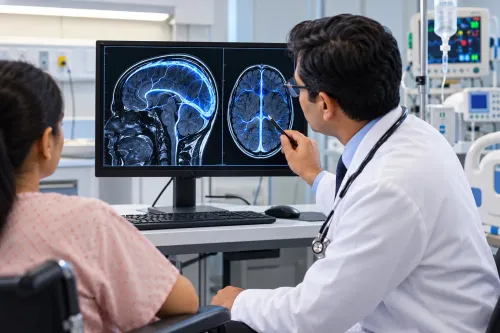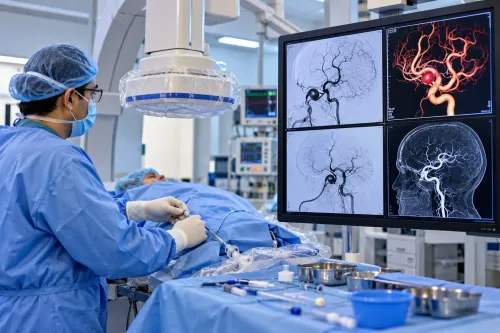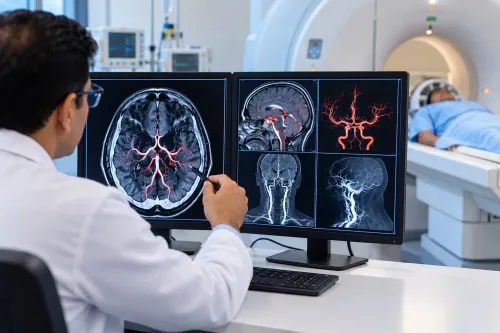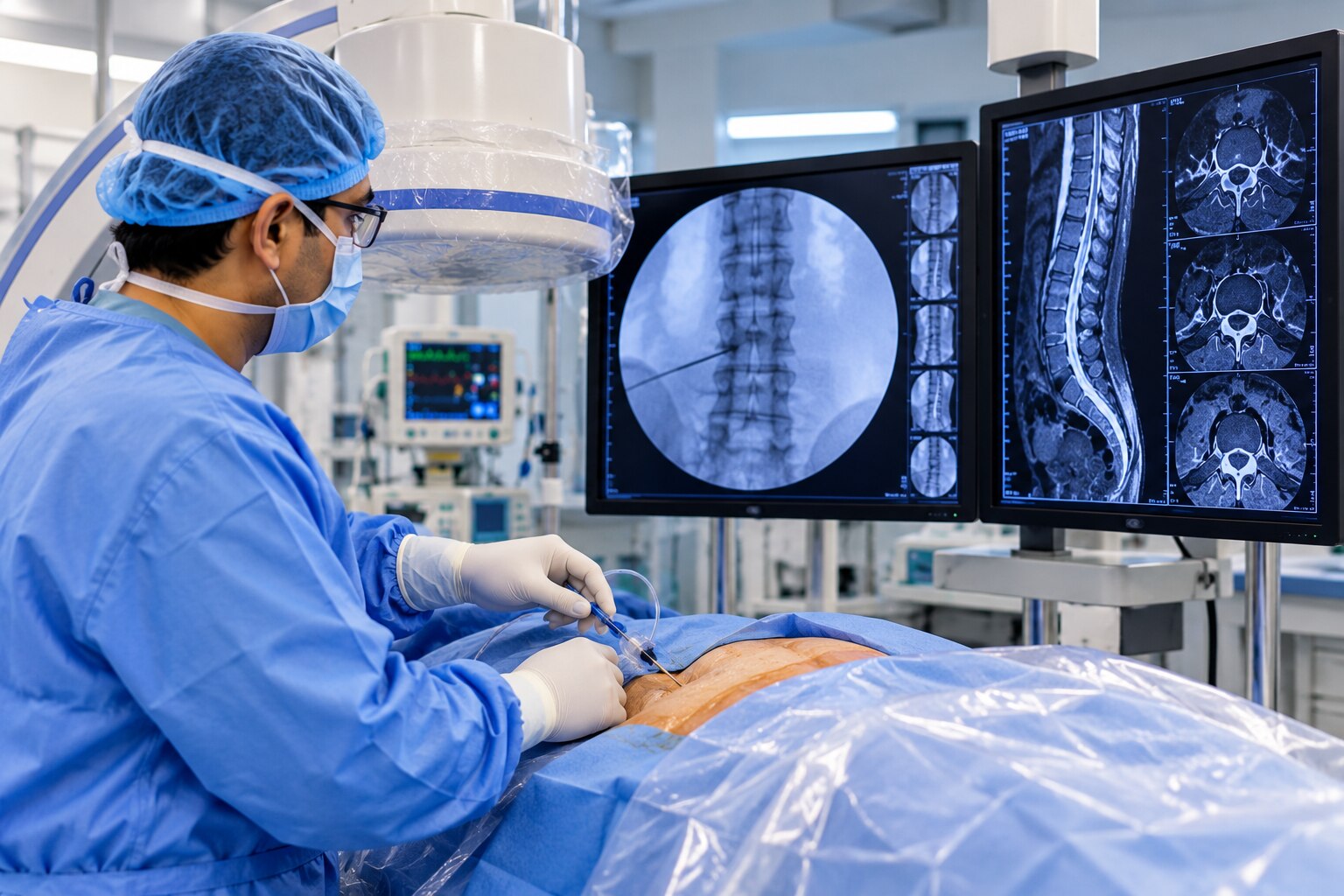
Back pain, weakness, sensory changes and bladder symptoms do not all come from a slipped disc. By separating vascular disorders from ordinary spine disease, understanding the diagnostic pathway and comparing treatment options, you can judge when an intervention offers a meaningful benefit and when conservative care or urgent surgery is more appropriate.
Key takeaways
- Confirm the diagnosis and treatment target before agreeing to an intervention.
- Ask whether spinal vascular imaging is needed for cord symptoms or abnormal vessels.
- Compare injections, catheter procedures, open surgery and non-procedural care.
- Choose a specialist who explains risks, alternatives, recovery and follow-up clearly.
What spinal intervention means and when it is justified
Spinal intervention uses imaging to guide a targeted procedure, such as an injection, biopsy, drainage, vertebral augmentation, tumour embolisation or catheter-based treatment of a blood-vessel abnormality. It is not the same as physiotherapy, medication or open spine surgery.
Any spinal intervention benefits in Pune depend on matching a proven cause to the right target, not treating an MRI finding alone.
Routine back pain without neurological warning signs usually calls for conservative care, not immediate imaging or an invasive procedure. Arrange urgent assessment for:
- Progressive leg weakness, worsening numbness or a deteriorating gait
- New loss of bladder or bowel control, or saddle numbness
- Sudden neurological deficit
- Severe back pain with fever
- New neurological symptoms with cancer, recent infection or immune suppression
These features can signal cauda equina compression, epidural infection, tumour, spinal cord ischaemia or a vascular lesion. Examination and targeted imaging help separate those causes from disc disease, spinal stenosis, inflammation and peripheral nerve disease.
| Option | What it involves | When it is justified |
|---|---|---|
| Medication or physiotherapy | Symptom control and rehabilitation | Uncomplicated back pain without red flags |
| Injection or vertebral procedure | Image-guided delivery or fracture stabilisation | A confirmed pain generator, fracture or selected structural problem |
| Vascular intervention | Angiography followed by embolisation or another catheter treatment | Spinal dural arteriovenous fistula, spinal AVM, cord AVM, aneurysm, vascular tumour or selected ischaemia; spinal digital-subtraction angiography maps the target before treatment |
| Open surgery | Direct decompression or lesion removal | Compression, anatomy or incomplete embolisation makes catheter treatment unsuitable |
How doctors find the cause before recommending a procedure
The diagnosis starts with the symptom pattern, not with a procedure. Doctors map weakness, numbness, pain, gait change and bladder or bowel symptoms against the spinal cord, nerve roots and peripheral nerves.
Progressive bilateral leg weakness, worsening balance and bladder changes suggest cord involvement; pain following one nerve with a disc bulge points more toward radiculopathy.
1. The examination tests strength, reflexes, sensation, coordination and walking. A sensory level on the trunk, brisk reflexes or a Babinski sign supports spinal-cord disease, while focal foot weakness with reduced reflexes may indicate disc disease or peripheral nerve disease.
2. Magnetic resonance imaging of the spine looks for disc herniation, canal stenosis, cord swelling, tumour, infection, inflammation and abnormal vessels. Contrast-enhanced MRI can show enhancement from tumour or infection; flow voids and swollen veins raise suspicion of a spinal dural arteriovenous fistula or arteriovenous malformation.
3. Doctors match the scan to the symptoms before calling it the cause. A disc bulge that does not compress the symptomatic root is an incidental finding, not a treatment target.
Blood tests, including complete blood count, C-reactive protein and erythrocyte sedimentation rate, support investigation of infection or inflammation, while biopsy may be needed for an uncertain tumour or infection.
4. If a vascular lesion remains possible, spinal digital-subtraction angiography maps feeding arteries, the fistulous point, venous drainage or an aneurysm. Electromyography and nerve-conduction studies help separate peripheral nerve disease from root or cord disease. A sudden deficit, fever with severe back pain, or new bladder dysfunction requires urgent assessment.
When spinal vascular intervention can protect the spinal cord
Catheter-based treatment can protect the spinal cord when a defined abnormal vessel threatens blood flow, causes venous congestion or feeds a tumour. Treatable examples include spinal dural arteriovenous fistula, spinal arteriovenous malformation, spinal cord arteriovenous malformation, spinal aneurysm and selected spinal vascular tumours; a few spinal cord ischaemic conditions also require endovascular assessment.
A spinal dural arteriovenous fistula is an acquired artery-to-vein connection that raises venous pressure and gradually damages the cord. Digital-subtraction spinal angiography maps the feeding artery, fistulous point, draining veins and normal arteries before treatment.
| Option | What it does | When it fits |
|---|---|---|
| Embolisation | Blocks the abnormal shunt or tumour-feeding vessel through a catheter | A safe catheter route reaches the target without blocking arteries supplying the cord |
| Surgery | Disconnects or removes the lesion directly | The shunt is inaccessible, embolisation would endanger spinal arteries, or durable disconnection needs open access |
| Combined treatment | Uses embolisation to reduce flow, followed by surgery or further embolisation | The lesion has multiple feeders, high flow, or incomplete initial closure |
The decision depends on anatomy, not on the label “minimally invasive.” Doctors weigh the shunt’s location, feeding arteries, venous drainage, embolic material, neurological status and the risk of spinal-cord ischaemia.
Spinal vascular intervention in Pune should therefore follow complete angiographic planning, with a clear answer on whether treatment aims to cure the lesion or only reduce flow.
How minimally invasive spine treatments compare with other options
The practical advantage of minimally invasive spine treatment in Pune is targeted access through a needle or catheter, not risk-free treatment. It can reduce pain, stabilise a fractured vertebra, obtain tissue, reduce tumour blood flow or close a vascular shunt without the muscle disruption of open surgery. The benefit depends on a proven target.
| Option | Practical benefit | Limit or trade-off |
|---|---|---|
| Medication and physiotherapy | Useful for uncomplicated pain, stiffness and deconditioning; no procedure-related bleeding or anaesthesia | Cannot remove a tumour, stabilise a collapsed vertebra or close a fistula; progress requires time and participation |
| Image-guided injections | Delivers steroid or anaesthetic near an inflamed nerve root and can provide temporary relief that supports rehabilitation | Relief may fade; it does not reverse severe compression, infection or a vascular lesion, and carries infection, bleeding and nerve-injury risks |
| Vertebral augmentation | Cement can stabilise selected painful compression fractures and improve movement | It does not treat every fracture or its cause; cement leakage, adjacent fracture and nerve injury are possible |
| Tumour embolisation | Blocks tumour-feeding vessels before surgery or biopsy, reducing operative bleeding in selected cases | It rarely removes the tumour; non-target embolisation can injure the spinal cord |
| Vascular treatment | Embolisation can close a spinal dural arteriovenous fistula or selected malformation without open exposure | Mapping is complex, treatment can be incomplete, and spinal-cord ischaemia, bleeding or recurrence can occur |
| Open surgery | Directly decompresses, removes or reconstructs when anatomy demands it | Larger wounds, longer recovery and greater physiological strain |
Progressive weakness, gait decline or new bladder, bowel or saddle symptoms require urgent assessment, not elective injection booking. If imaging shows no specific target, medication and physiotherapy are usually safer starting points.
How to choose a specialist and prepare for a spinal procedure
Before agreeing to treatment, ask what the lesion is: a spinal dural arteriovenous fistula, arteriovenous malformation, aneurysm, tumour feeder, or another abnormality. Ask which MRI, CT angiography, or spinal digital-subtraction angiography proves the target, and whether the proposed treatment aims to cure it or only reduce blood flow.
- What is the alternative: observation, open surgery, medication, or combined treatment?
- Which embolic material will you use, and how will you protect arteries supplying the spinal cord?
- What happens if embolisation is incomplete, and how will you detect recurrence?
- What are the specific risks of bleeding, contrast reaction, nerve injury, spinal-cord ischaemia, infection, and radiation exposure?
- Who manages an emergency complication, and what recovery time and follow-up imaging should I expect?
Compare the proposed procedure with its purpose before deciding:
| Option | Main purpose | Ask before consent |
|---|---|---|
| Spinal angiography | Maps feeding arteries, fistulous point, and venous drainage | Is this diagnostic only, or will treatment follow immediately? |
| Embolisation | Blocks selected abnormal blood flow | Is complete closure realistic, and might repeat treatment or surgery be needed? |
| Open surgery | Removes or disconnects a lesion directly | Why is surgery safer or more durable here? |
A spinal intervention specialist in Pune should have current endovascular neurovascular practice, spinal angiography training, embolic-material expertise, and a plan for complications; a general spine or pain qualification alone does not establish this. Dr Santosh Patil-Endovascular Neuro Surgeon Pune is relevant to evaluate only if these credentials match the procedure offered.
Before admission, disclose anticoagulants, diabetes, kidney disease, and contrast allergies; confirm fasting, medication instructions, transport home, and the follow-up schedule.
Related service
Spinal Interventions What is Spinal Interventions ? Spinal interventions represent a critical aspect of neurovascular care, addressing a wide spectrum of conditions... View service → |
Frequently asked questions
What does spinal intervention mean, and when is it justified?
Spinal intervention is an imaging-guided procedure such as an injection, biopsy, drainage, vertebral augmentation, tumour embolisation or catheter-based vascular treatment. It is justified when the identified problem has a clear treatment target and the expected benefit outweighs the risks.
How do doctors find the cause before recommending a spinal procedure?
Doctors review your symptoms, neurological examination and previous scans, then select tests such as MRI, CT, CT myelography or spinal angiography when needed. The findings must match the pain, weakness, sensory changes or other symptoms before treatment is recommended.
When can spinal vascular intervention protect the spinal cord?
Spinal vascular intervention addresses abnormal blood vessels that can reduce cord function through bleeding, venous congestion or altered blood flow. Catheter angiography identifies the vessels, and embolisation or another endovascular treatment can target the abnormal connection.
How do minimally invasive spine treatments compare with other options?
Minimally invasive procedures use a small access point and imaging guidance, while medication, physiotherapy and open surgery serve different problems. Compare expected symptom relief, neurological risk, anaesthesia, hospital stay, recovery time and the chance of needing further treatment.
How should you choose a spinal intervention specialist in Pune?
Ask about the exact diagnosis, proposed procedure, alternatives, complications, operator experience with that procedure, hospital facilities and follow-up plan. Bring MRI or CT images, reports, medication details, allergy history and previous treatment records.
Keywords