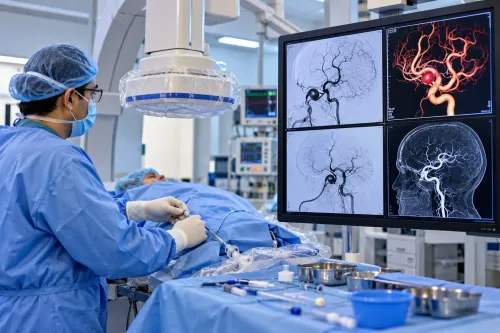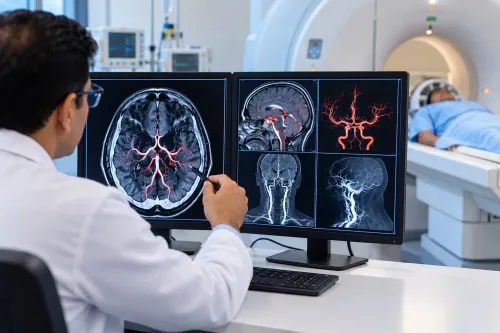
Suspected cerebral venous thrombosis needs emergency assessment, venous brain imaging and a treatment team that can manage anticoagulation, seizures, raised intracranial pressure and neurological deterioration. You will learn which symptoms require immediate transfer, which Pune hospital capabilities to confirm, and when standard treatment differs from catheter-based intervention.
Key takeaways
- Seek emergency care for headache with seizure, weakness, confusion, fainting, or vision loss.
- Doctors use brain imaging and venous scans to confirm CVT and rule out other causes.
- Anticoagulation prevents clot growth even when CVT has caused bleeding.
- Severe CVT requires hospital access to intensive care, neuroimaging, and endovascular treatment.
When symptoms mean you need emergency care, not an outpatient appointment
Call emergency services and arrange immediate hospital transfer if a new or rapidly worsening headache comes with a seizure, weakness, confusion, fainting, or vision loss. Suspected cerebral venous thrombosis (CVT), also called cerebral venous sinus thrombosis, can raise pressure inside the skull, cause brain injury or bleeding, and deteriorate quickly.
Do not drive if you are drowsy, confused, weak, or unable to see clearly.
Treat these signs as an emergency:
- A first seizure, repeated seizure, or seizure lasting five minutes
- New weakness, numbness, facial drooping, slurred speech, or difficulty understanding speech
- Blurred or double vision, a missing area of vision, or brief episodes of visual blackout
- Confusion, extreme sleepiness, collapse, fainting, or difficulty waking
- A sudden “worst-ever” headache, or a headache that rapidly intensifies with vomiting
- A new persistent headache during pregnancy or after delivery, or with dehydration, infection, oestrogen contraception, cancer, or a clotting disorder
| Presentation | Appropriate action | Why it matters |
|---|---|---|
| New persistent headache without other signs | Same-day hospital assessment | CVT can begin with headache alone |
| Headache plus seizure, visual change, weakness, or confusion | Emergency transfer now | Raised intracranial pressure or brain injury may be developing |
| Collapse, reduced consciousness, or repeated seizures | Ambulance and emergency resuscitation | Airway protection, urgent imaging, and specialist treatment may be needed |
A search for “cerebral venous thrombosis for treatment available in Pune” should not delay transfer. “Brain clot” does not identify the clot’s location or treatment; go to a hospital with emergency imaging and neurology support.
How doctors confirm CVT and separate it from other causes of headache
Doctors confirm CVT by combining a neurological examination with venous imaging, not by symptoms alone. They check alertness, speech, strength, sensation, coordination, seizures, eye movements and the optic discs for papilloedema from raised pressure. A non-contrast CT may show haemorrhage, swelling or a venous infarct, but a normal result does not exclude CVT.
The decisive tests are CT venography (CTV) or MRI with MR venography (MRV). These scans show a filling defect or absent flow in a cerebral vein or dural sinus. MRI also detects venous infarction, swelling and small haemorrhages.
A lumbar puncture does not diagnose CVT and can be dangerous when pressure or a mass effect is present.
Doctors separate the main alternatives using the examination and scan pattern:
| Cause | Clues that favour it | Test or finding that separates it |
|---|---|---|
| Migraine | Recurrent, similar attacks; normal examination between attacks | No venous filling defect on CTV or MRV |
| Meningitis | Fever, neck stiffness, light sensitivity, altered behaviour | Infection tests and cerebrospinal-fluid analysis after imaging |
| Haemorrhage | Sudden severe headache or reduced consciousness | Blood visible on non-contrast CT |
| Arterial stroke | Sudden focal deficit in an arterial territory | CT or MR angiography shows arterial blockage, not sinus clot |
| Brain mass | Progressive headache, vomiting, personality or seizure changes | MRI shows a space-occupying lesion |
A “brain clot” search does not identify the clot’s location or treatment. Cerebral venous sinus thrombosis treatment in Pune requires a hospital that can perform CTV or MRV and involve neurology, neurosurgery and, when indicated, venous endovascular specialists.
What anticoagulation treatment involves after CVT is confirmed
Once venography confirms CVT, doctors usually start therapeutic-dose anticoagulation promptly. It prevents clot extension, reduces new venous infarction and gives the body time to clear the blockage.
A haemorrhagic venous infarct is bleeding caused by obstructed venous drainage, not proof that anticoagulation caused the bleed; it is therefore not, by itself, a reason to withhold treatment.
| Medicine | How it is given | Main role |
|---|---|---|
| Low-molecular-weight heparin | Injection under the skin | Common initial treatment with predictable dosing |
| Unfractionated heparin | Continuous intravenous infusion | Useful when rapid reversal or an urgent procedure may be needed |
| Oral anticoagulant | Tablet after, or sometimes during, the initial phase | Longer-term prevention of clot extension and recurrence |
Heparins act quickly and are used in hospital at a treatment dose, not the smaller dose used only to prevent clots in immobile patients. Unfractionated heparin requires blood-test monitoring and can be stopped rapidly; low-molecular-weight heparin needs fewer adjustments but requires consideration of kidney function and body weight.
Oral options include warfarin and selected direct oral anticoagulants; pregnancy, kidney disease, cancer, antiphospholipid syndrome and drug interactions affect the choice.
A search for brain clot treatment in Pune can lead to arterial-stroke services, but CVT needs venous expertise. Catheter thrombectomy is reserved for selected patients who deteriorate despite anticoagulation or have threatened brain function; it is not routine first-line treatment.
Which Pune hospital services matter when CVT is severe
The search phrase cerebral venous thrombosis for treatment available in Pune points to a tertiary hospital, not an outpatient brain-clot clinic. Cerebral venous sinus thrombosis treatment in Pune is generally available, but the specialist and procedure may not be present at every hospital or at every hour.
Before transfer, ask the receiving emergency desk or referring doctor to confirm:
- 24/7 emergency neurology or stroke assessment
- CT with CT venography and MRI with MR venography
- An ICU able to manage seizures, coma and raised intracranial pressure
- An on-site neurosurgeon for decompression or other pressure-relieving surgery
- An interventional neuroradiologist who performs venous sinus thrombectomy or catheter-directed thrombolysis
| Service | What to confirm | Why it matters |
|---|---|---|
| Emergency neurology | Stroke or neurology team available now | CVT can worsen through seizures, bleeding or pressure |
| Imaging | CT/MR venography interpreted urgently | A routine CT may miss the venous clot |
| ICU and neurosurgery | Neurocritical care and decompression capability | Severe swelling can threaten vision or life |
| Endovascular service | Catheter angiography and venous thrombectomy devices | Arterial stroke retrieval does not prove venous expertise |
Endovascular treatment is reserved for selected patients who deteriorate despite anticoagulation, have threatened brain or vision function, or cannot receive anticoagulation. Dr Santosh Patil-Endovascular Neuro Surgeon Pune can help assess whether catheter-based treatment fits the case, while the hospital must still confirm immediate ICU and surgical backup.
Related service
Cerebral Venous Thrombosis What is Cerebral Venous Thrombosis- Cerebral venous thrombosis (CVT) is a rare but serious condition characterized by the formation of blood clots... View service → |
When to ask for a CVST specialist and what happens after the acute phase
Do not choose a doctor by the phrase “brain clot treatment in Pune” alone.
Ask which specialist will coordinate care: a neurologist or stroke physician usually confirms the diagnosis, manages anticoagulation and seizures, and arranges follow-up; a neurosurgeon treats dangerous brain swelling, hydrocephalus or raised intracranial pressure, including decompressive surgery; an interventional neuroradiologist performs catheter angiography and, in selected life-threatening cases, venous sinus thrombectomy or thrombolysis.
One doctor may not provide all three services.
Ask the hospital to confirm these services before a stable transfer:
- A neurology or stroke team reviewing the case
- Neurosurgical assessment for worsening consciousness, mass effect or uncontrolled intracranial pressure
- An interventional neuroradiologist who performs cerebral venous sinus procedures, not only arterial stroke thrombectomy
- Eye and neurological follow-up for papilloedema, persistent headache, seizures, weakness, vision changes, memory or concentration problems
- Repeat CT, MRI or venography when symptoms persist, worsen or the treating team needs to assess recanalisation
Anticoagulation usually continues after discharge, but not automatically for life. A transient trigger such as postpartum status, dehydration or an oestrogen medicine often leads to about 3–6 months; an unprovoked event often leads to 6–12 months. Recurrent thrombosis, active cancer or persistent major thrombophilia can justify longer or indefinite treatment.
A CVST specialist in Pune should review the trigger, bleeding risk, clot recurrence risk and pregnancy plans before changing or stopping the medicine.
Frequently asked questions
When does suspected cerebral venous thrombosis require emergency care?
Call emergency services for a new or rapidly worsening headache with seizure, weakness, confusion, fainting, or vision loss. These symptoms can indicate rising pressure inside the skull or brain injury.
How do doctors confirm cerebral venous thrombosis?
Doctors assess your symptoms and use brain imaging with venous studies, such as CT venography or MR venography, to identify a blocked cerebral vein or venous sinus and distinguish CVT from other headache causes.
What does anticoagulation treatment involve after CVT is confirmed?
Doctors use anticoagulant medicine to prevent the clot from extending and to support recanalisation. Treatment choices and duration depend on the scan findings, bleeding risk, cause of the clot, and follow-up assessment.
Which hospital services matter when CVT is severe?
Severe CVT requires rapid access to emergency assessment, neuroimaging, intensive care, neurology, neurosurgery, and endovascular intervention when the condition worsens despite medical treatment.
When should you ask for a CVST specialist in Pune?
Ask for a CVST specialist when imaging suggests cerebral venous sinus thrombosis, symptoms worsen despite treatment, seizures or neurological deficits occur, or the case requires endovascular evaluation. Follow-up also addresses anticoagulation, seizures, headaches, vision, and the underlying cause.
Keywords