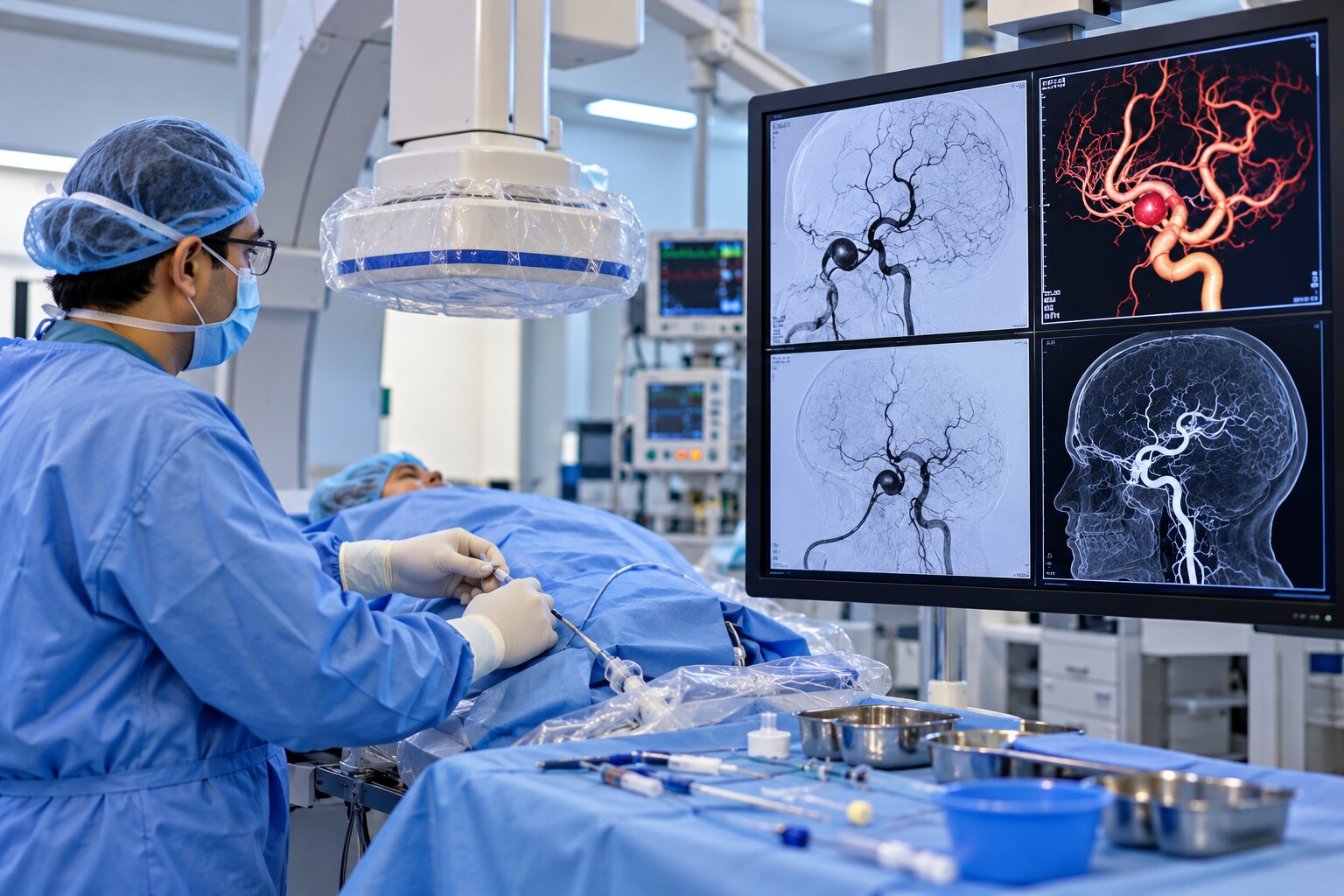
Sudden weakness, speech trouble, vision loss, seizures, collapse, or a severe headache can signal a time-critical problem rather than an appointment to schedule. You will learn which specialist coordinates care, how imaging and catheter procedures guide treatment, and what to ask before choosing endovascular care.
Key takeaways
- Call emergency services for sudden weakness, facial droop, or speech trouble.
- Record the exact time symptoms began or the person was last well.
- CT, CT angiography, MRI, and catheter angiography answer different questions.
- Treatment decisions depend on the vessel problem, timing, risks, and overall health.
When a Neurovascular Problem Needs Emergency Action
A sudden facial droop, one-sided arm weakness or speech difficulty is an emergency, not a routine appointment with a neurovascular specialist in Pune. Call local emergency services and note the exact time the person was last known to be well, even if symptoms appeared during sleep.
Treat these signs as emergencies:
- Sudden weakness or numbness on one side
- New trouble speaking, understanding, walking or maintaining balance
- Sudden vision loss, seizure or collapse
- A sudden, severe headache that reaches maximum intensity immediately
Do not give food, drink or aspirin unless emergency clinicians advise it. Bring the person’s medication list, anticoagulant details and medical history, but do not delay transport to collect documents.
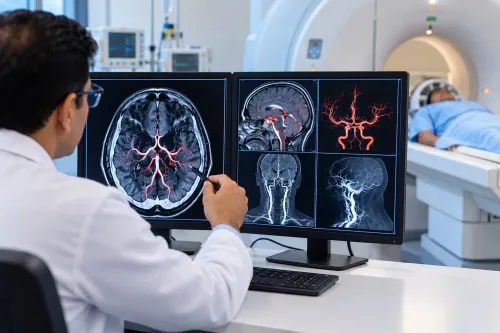
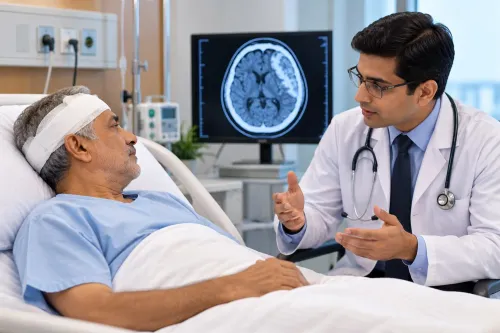
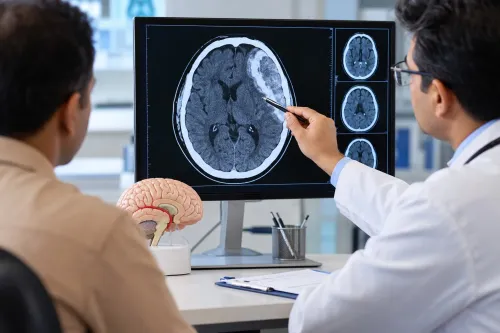
At hospital, the emergency team checks breathing, blood pressure, blood glucose and neurological function. A non-contrast CT scan looks for brain bleeding; a normal early CT does not exclude an ischaemic stroke. CT angiography then looks for a blocked artery, while CT perfusion or MRI can help estimate salvageable brain tissue in selected patients.
If an eligible clot-related stroke is confirmed, doctors assess intravenous thrombolysis and mechanical thrombectomy. A ruptured aneurysm or other bleeding requires urgent specialist review and vascular imaging, often including catheter angiography. The interventional neuro radiologist may then recommend catheter-based treatment, but the choice depends on the scan, bleeding pattern, timing and overall condition.
Waiting for an outpatient review can remove time-sensitive treatment options.
Which Specialist Does What in Neurovascular Care?
The practical difference is the job each specialist performs: emergency doctors stabilise you, neurologists manage brain and nerve disease, and procedural or surgical specialists repair blocked, bleeding, or abnormal vessels.
| Role | Main responsibility | When you need one |
|---|---|---|
| Emergency physician | Confirms immediate danger, stabilises breathing and blood pressure, orders urgent brain and vessel imaging, and activates stroke transfer. | Sudden weakness, speech trouble, collapse, seizure, vision loss, or severe headache. |
| Neurologist | Diagnoses stroke and other neurological disease, assesses disability, prescribes medical prevention, and coordinates rehabilitation. | During admission and follow-up, including decisions about thrombolysis or longer-term medicines. |
| Neuroradiologist | Reads CT, MRI, and angiographic scans to identify an occlusion, aneurysm, malformation, or bleeding pattern. | When imaging must answer what the lesion is and where it lies. |
| Interventional neuro radiologist | Uses image-guided catheters inside brain or spinal vessels for thrombectomy, coiling, flow diversion, stenting, or embolisation. | When a catheter procedure can restore flow or seal an abnormal vessel. |
| Neurosurgeon | Treats conditions through open surgery, such as clot evacuation, decompression, or selected aneurysm and malformation operations. | When anatomy, bleeding, swelling, or treatment risk favours surgery. |
| Vascular surgeon | Treats larger vessels outside the brain, including carotid artery disease. | When neck or peripheral vascular repair is required. |
An interventional neuro radiologist for neurovascular problems in Pune may therefore work alongside a neurologist, neuroradiologist, emergency physician, and neurosurgeon. One patient may need several specialists because imaging, medical stabilisation, catheter treatment, surgery, and intensive-care monitoring solve different parts of the same problem.
From CT to Angiography: How Doctors Find the Problem
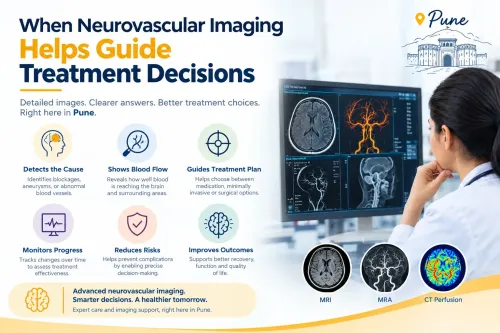
A normal early CT does not rule out an ischaemic stroke. Doctors choose imaging to answer different questions: Is there bleeding? Which vessel is blocked? How much brain remains salvageable?
- Non-contrast CT detects brain haemorrhage, swelling, and established infarction. It is usually the first scan because it is fast and guides urgent treatment.
- CT angiography (CTA) uses iodinated contrast to map arteries from the aortic arch through the brain. It can show a large-vessel blockage, aneurysm, narrowing, dissection, or arteriovenous malformation.
- CT perfusion estimates blood flow and separates irreversibly damaged tissue from potentially salvageable brain. It helps assess selected patients for thrombectomy.
- MRI, including diffusion-weighted imaging and MR angiography, detects early infarction and maps vessels without CT radiation. It takes longer and is not suitable for every emergency.
Catheter cerebral or spinal angiography gives the most detailed view of small vessels.
After local anaesthetic, the doctor guides a thin catheter through an artery in the wrist or groin, injects contrast, and records rapid X-ray images while subtracting the bones; selective catheterisation can reveal the feeding arteries and draining veins of a malformation or fistula.
During endovascular neuro care in Pune, this study can also lead directly to embolisation, stenting, or another treatment. Ask the team to review kidney function, pregnancy status, previous contrast reactions, anticoagulants, and bleeding risk. Risks include access-site bleeding, contrast reaction, kidney injury, radiation exposure, and procedure-related stroke.
What Endovascular Procedures Can Treat
A catheter passed through an artery in the groin or wrist lets the specialist reach brain or spinal vessels without opening the skull. During neurovascular intervention in Pune, imaging guides each device to restore flow, seal a weak vessel, or block an abnormal connection.
| Procedure | How it works | Conditions it can treat |
|---|---|---|
| Mechanical thrombectomy | A stent retriever or suction catheter captures and removes a clot. | Selected acute ischaemic strokes caused by a large-vessel blockage. |
| Aneurysm coiling | Detachable platinum coils fill the aneurysm sac, slowing blood flow until it clots. A balloon or stent can support coils across a wide neck. | Ruptured aneurysms causing subarachnoid haemorrhage and selected unruptured aneurysms with meaningful rupture risk. |
| Flow diversion | A fine-mesh tube redirects blood along the parent artery, allowing the aneurysm to seal gradually. | Selected large, wide-necked, fusiform, or otherwise difficult intracranial aneurysms. |
| Stenting | A metal scaffold props open a narrowed artery or supports another treatment. | Selected carotid or intracranial stenosis, and wide-necked aneurysms during stent-assisted coiling. |
| Embolisation | Coils or liquid agents block abnormal blood flow. | Brain or spinal arteriovenous malformations and dural arteriovenous fistulas; treatment may be definitive or precede surgery or radiosurgery. |
The best option depends on vessel anatomy, aneurysm shape and location, rupture status, brain injury, and overall health. One patient may need staged procedures rather than a single session.
How Doctors Decide Whether Endovascular Treatment Is Right for You
Suitability depends on the lesion, its immediate danger, and your ability to tolerate treatment. Doctors review CT, MRI, and digital-subtraction angiography for an aneurysm’s size, location, shape, neck, branch vessels, and rupture status. They also consider symptoms, last-known-well time in stroke, age, blood-thinning medicines, kidney function, anaesthetic risk, and overall health.
For an arteriovenous malformation or dural arteriovenous fistula, the team maps feeding arteries, draining veins, and any high-risk flow pattern. Liquid embolic agents, coils, or other devices may cure a selected lesion, reduce its size before microsurgery or radiosurgery, or require several sessions. A single procedure is not automatically the safest procedure.
Before consenting, ask the neurovascular specialist in Pune to explain:
- The untreated risk and the specific goal of treatment
- Alternatives, including medical management, microsurgery, radiosurgery, or observation
- Risks of vessel perforation, dissection, intracranial bleeding, stroke, infection, anaesthesia, device migration or failure, and death
- The expected number of sessions, recovery plan, follow-up scans, and the chance of needing further treatment
To evaluate endovascular neuro care in Pune, ask who performs the procedure, whether the hospital provides 24-hour neurological and intensive-care support, and how emergencies are handled after discharge. Confirm that contrast reactions, kidney injury, access-site bleeding, and procedure-related stroke are discussed for angiography.
Dr Santosh Patil-Endovascular Neuro Surgeon Pune can be assessed by the same questions: insist on a clear diagnosis, a documented treatment rationale, and a realistic alternative before choosing neurovascular intervention in Pune.
Related services
Endovascular Neuro Surgeon/Interventional Neuro Radiologist Endovascular Neuro Surgeon/Interventional Neuro Radiologist in Pune Dr Santosh Patil is the Best Endovascular Neuro Surgeon in Pune and Interventional Neuro Radiologist in Pune, Maharashtra and all over India. View service → |
Spinal Interventions What is Spinal Interventions ? Spinal interventions represent a critical aspect of neurovascular care, addressing a wide spectrum of conditions... View service → |
Frequently asked questions
When does a neurovascular problem need emergency action?
Sudden facial droop, one-sided weakness, speech difficulty, vision loss, severe imbalance, or an abrupt intense headache requires emergency assessment. Call local emergency services and record the last-known-well time.
Which specialist treats neurovascular problems?
A neurologist assesses brain and nervous-system function, a neurosurgeon handles open surgical options, and an interventional neuroradiologist performs image-guided endovascular procedures.
How do doctors find a neurovascular problem?
Doctors combine the neurological examination with CT or MRI and vessel imaging such as CT angiography, MR angiography, or catheter cerebral angiography.
What can endovascular procedures treat?
Endovascular treatment can address selected strokes caused by large-vessel blockage, brain aneurysms, arteriovenous malformations, dural arteriovenous fistulas, and other vessel disorders.
How do doctors decide whether endovascular treatment is suitable?
They assess the diagnosis, vessel anatomy, symptom timing, brain tissue at risk, bleeding risk, existing illnesses, and whether medication or open surgery offers a safer option.
Related services
Neurovascular Imaging What is Neurovascular Imaging- Neurovascular imaging plays a crucial role in the diagnosis, characterization, and treatment planning of the... View service → |
Ischemic Stroke Treatment in Pune Ischemic Stroke Treatment in Pune What is Ischemic Stroke ? Ischemic stroke, characterized by the obstruction of blood flow to the brain, demands swift and comprehensive intervention... View service → |
Cerebral Aneurysm Treatment in Pune Cerebral Aneurysm Treatment in Pune What is Cerebral Aneurysm ? Cerebral aneurysms represent a critical neurovascular condition characterized by weakened arterial walls, leading to... View service → |
Head And Neck Vascular Malformations Head And Neck Vascular Malformations What is Head & Neck Vascular Malformations- Head & Neck Vascular Malformations encompass a diverse group of anomalies involving abnormal blood... View service → |
Keywords